The Benefits of Solid Plumbing Technology Program Training

Making a living as a plumber requires a solid career training program that can help to make the dream become a reality.
Effective plumbing training can help prepare students for a myriad of career opportunities, which may include working in residential and commercial plumbing industries, as well as climate control systems.
Pipes are used extensively from water treatment plants to homes and skyscrapers. Plumbers also have the additional option of working in other similar career fields as a pipe fitter, pipe layer or steamfitter.
Plumbing technology program training can also prepare a candidate to seek employment in areas such construction occupations as the installation of plumbing fixtures and appliances, which includes bathtubs, showers, sinks, dishwasher and water heaters.

Error Message Guidelines

Summary:
Established wisdom holds that good error messages are polite, precise, and constructive. The Web brings a few new guidelines: Make error messages clearly visible, reduce the work required to fix the problem, and educate users along the way.
The guidelines for creating effective error messages have been the same for 20 years. Good error message should include:
  • Explicit indication that something has gone wrong. The very worst error messages are those that don't exist. When users make mistakes and get no feedback, they're completely lost. Email, for example, offers several situations where explicit indication would be useful. Such as: When you send a message that gets eaten by the system and never reaches the recipient. Another good example? When you state in an email that you'll include an attachment, but forget to do so. Finally a job for that annoying paperclip: "You seem to want to attach a file to this message, but you have not done so. Would you like to attach one now?"
  • Human-readable language, instead of obscure codes or abbreviations such as "an error of type 2 has occurred."
  • Polite phrasing that doesn't blame users or imply that they are either stupid or doing something wrong, as in "illegal command."
  • Precise descriptions of exact problems, rather than vague generalities such as "syntax error."
  • Constructive advice on how to fix the problem. For example, instead of saying "out of stock," your error message should either tell users when the product will be available or provide a way for users to ask to be notified when the product is restocked.
The Web's most common error message, 404, violates most of these guidelines. I recommend that you write a custom 404 error message instead of relying on the server's built-in "page not found" message.

New Guidelines

The complexity of Web pages has introduced the need for a guideline that wasn't required in the old days. With a DOS interface, users type a command and the error message is displayed on the next line of the TTY. In modern GUIs, users click a command and the error message is displayed in a big dialog box in the middle of the screen, and it doesn't go away until users acknowledge it. On the Web, however, error messages are often hidden as modest text on an overloaded page, leading to a new guideline: Error messages should be
  • Visible and highly noticeable, both in terms of the message itself and how it indicates which dialogue element users must repair.
I have frequently observed users make a mistake in a Web form, only to get exactly the same form back from the server with no visible indication of what went wrong. Often, a small error message appeared on the top of the page, but since users look at the page's actionable part first (i.e., the area with the form fields), they don't typically notice the error. A related design flaw is to indicate an error state solely by turning the field label red. This violates one of the oldest and simplest rules for making technology accessible to users with disabilities: Never use color as the only encoding mechanism; always include redundant cues that color-blind users can see.
Two other guidelines can make the error situation less unpleasant for users:
  • Preserve as much as the user's work as possible. Let users correct errors by editing their original action instead of having to do everything over again. For example, in presenting search results, show a search box with the user's original query terms to facilitate revisions. If no hits were found, let users search a wider scope with a single click.
  • Reduce the work of correcting the error. If possible, guess the correct action and let users pick it from a small list of fixes. For example, instead of just saying "city and zip code don't match," let users click on a button for the city that matches the zip code they entered.

Opportunity to Educate Users

Finally, you probably already know Nielsen's First Law of Computer Documentation: people don't read it. This finding is even stronger for websites, where users truly shy away from any reading that is not essential to their task. Click on Help? Never. Users read system documentation only when they are in trouble (that's the Second Law). They are particularly attentive when they want to recover from an error. Given this, you can use error messages as an educational resource to impart a small amount of knowledge to users. Of course, error messages should be brief and to the point, as should all Web content. However, error messages can still teach users a bit about how the system works and give them information they need to use it better. To further that end, the Web's underlying technology makes another guideline possible:
  • Hypertext links can be used to connect a concise error message to a page with additional background material or an explanation of the problem. (Don't overdo this, though.)

program overview

The interdisciplinary program in Internet Technology prepares students for careers in Internet project development and advanced study in information technology or computer science. Students in this program learn about the structure and operation of the Internet in an applied context of web site development, database management and computer programming. They also learn conceptual tools for analyzing and evaluating the Internet, both as a vehicle for information exchange and as a tool of commerce. Majors are frequently involved on projects, as individuals and as team members, in an environment that stresses both theoretical understanding and experiential learning.
Internet Technology majors take courses in a variety of disciplines, including business, computer science, information technology, mass communication, philosophy and psychology, to help develop the full range of skills necessary for success in several web development professions. Two major tracks are available, the standard and the intensive tracks. The intensive track requires more work with formal reasoning and mathematics and delves more deeply into the computer science behind the Internet. Students interested in graduate study are strongly encouraged to pursue the intensive track.
Both major tracks are rich in free electives; eight courses in the standard track, seven in the intensive. Students are encouraged to complement their degree by choosing wisely from courses in accounting, computer science, economics, finance, legal studies, management, marketing, mathematics, mass communication, philosophy, political science, psychology, sociology, and visual communication. Due to overlapping course requirements between programs, minors in business administration, computer science, mathematics and mass communication are easily attainable by adding a small number of courses to the Internet Technology curriculum.
In addition to coursework, students pursuing both major tracks are required to complete an internship or co-op, and a senior project that will be presented to other majors and faculty prior to graduation. The senior project may be prepared in conjunction with the internship or co-op where circumstances permit. Qualifying students may do their internship or co-op in the program's Internet Applications Laboratory, a collaborative learning facility that has developed several internationally recognized Internet projects. To help teach students the skills needed to remain current on Internet Technology, majors are also required to participate in the program's proseminar, a series of regular meetings during which students and faculty make presentations on emerging Internet technologies.
To supplement other majors on campus, the Internet Technology program offers a 21-hour minor that teaches the basic elements of web site design, computer programming, network structure and configuration, and database management. Though generally applicable to most majors at UE, this minor is particularly useful for majors in business, education and mass communication.
Sample Curriculum
First Year
IT 120 Introduction to Internet Applications 3
PSYC 121 Introduction to Psychology 3
World Cultures I 3
American Traditions Elective 3
Elective (Intensive Track: MATH 221 Calculus I) 3/4
 
15/16
ECON 102 Principles of Microeconomics 3
MATH 134 Survey of Calculus (Intensive Track: MATH 222 Calculus II) 3/4
World Cultures II 3
Creative Dimensions Elective 3
Elective 3
 
15/16
Second Year
CS 210 Introduction to Computer Science 4
IT 351 Online Media I 3
PHIL 231 Symbolic Logic 3
Foreign Language 111 3
International Perspectives Elective 3
ENGR 90 Co-op/Internship Orientation 0
 
16
CS 215 Data Structures and Algorithms 3
IT 352 Online Media II 3
MATH 370 Discrete and Combinatorial Math 3
Foreign Language 112 3
Health and Wellness 1
Philosophical/Spiritual Dimensions Elective 3
 
16
Third Year
IT 310 Internet Networking, Hardware and Software Applications (Intensive Track: CS 475 Networks) 3
MGT 300 Principles of Management 3
Natural Science Elective with Lab 4
Elective 3
Elective 3
 
16
CS 290 Object Oriented Design and Programming 3
QM 227 Introduction to Statistics (Intensive Track: ENGR 390 Applied Engineering Math) 3
IT 320 Information Modeling, Storage, and Retrieval (Intensive Track: CS 440 Databases) 3
MKT 325 Introduction to Marketing 3
Elective 3
 
15
Fourth Year
CS 390 Software Engineering 3
IT 444 Information and Technology 3
MKT 470 E-Marketing 3
Technical Elective 3
Elective 3
 
16
MCOM 485 Mass Communication Law and Ethics 3
IT 490 Information Theory and the Internet (Senior Seminar) 3
Technical Elective 3
Elective 3
Elective 3
 
15

internet technology


The World Wide Web, scarcely six years old, is already causing significant change. Its scope crosses national boundaries bringing far away places close and altering the very fabric of society. Accessible, two-way interactive information exchange is transforming human relationships in every aspect from economics to expressions of affection.
A high school senior is able to check his school's web site to see what he missed while away on a field trip; then with a few clicks of a mouse, he's listening to the latest release of his favorite recording artist. His little brother checks out the newest toys on the market, making note of what he wants for his birthday. He easily writes Grandma, sending along pictures taken with the family's new digital camera. In a matter of moments, Grandma receives the email from her grandson. She orders gifts in return, checks her investments and applies for a renewal of her driver's license.
The pace of life increases with the speed of transmission, yet, in ways that are easy enough to manage. At the same time, old practices and attitudes are challenged by these transformations creating an environment that is difficult to understand, much less develop with knowledge, foresight and skill.
This makes it clear that the Internet is not a series of computers connected by cable, but a global, interactive system of information exchange. It is as much a form of media as it is a computer network; but even here, it is not media in the traditional sense. Interactivity changes everything. Making good use of the Internet begins with a firm foundation in computer science. But understanding information exchange is also necessary, and this means understanding people and the social structures in which they operate. It also means knowing something about graphic design, information theory, the history of information technology, online law and ethics, and the economic forces that drive technological change.
This explains why the Internet Technology program at the University of Evansville is intentionally interdisciplinary. Knowledge of computers is essential, but successful Internet development requires more.

Boli Muentes’s Composite ARF Tucano

What can I say about this plane. It has seen coverage in a few different magazines. This is the COMP ARF Tucano.
This plane is powered by a Jet Central Turbo Prop. The plane came in at 42lbs Dry. It fly's great. My favorite part of seeing this fly is the smoke system. When you dump the smoke oil into the twin stack you get two smoke trails. Cool to see. I am doing another Tucano that will be finished in Oct of 2010. This one belongs to a friend of mine and I will be able to use it to fly formation with Boli.

RCS 400cc Radial engine with electronic ignition


 RCS 400cc  Radial engine with electronic ignition. - Special Order Only - Special $500 off!
Yes, these are the sweetest engines in all of RC. They look real and they sound real. There is no mistaking the sound. Check out the videos under the videos tabs. If these engines don't give you chills, you need to find a different hobby. They are very reliable as well! You might think with a multitude of pushrods and special ignition that they would be unreliable, but they are not! They take more care and maintenance, but the results are well worth it. Just ask all the top modelers who fly them. We also offer a host of excellent propellers from Biela, TBM, MSC, Mejzlik, PT Models, Xoar and others. We offer 2-blade, 3-blade and even 4-blade props which not only look scale but offer high performance.

Welded-Steel Housing for Industrial Hardware


Amplicon's Industrial Computing group has released a range of industrial-grade cabinets suited to housing Amplicon's industrial rackmount computers, data communication and test equipment. Designed for the rigours of industrial-grade applications, the range is constructed from a rugged, welded-steel housing with mesh doors, to provide optimal airflow for the valuable industrial hardware contained within.

Available in a wide range of sizes to suit the hardware required, with heights up to 45U and depths to 1,200mm, the cabinets have the potential to allow up to 45U of rackmount equipment to be consolidated into a compact 600 x 600mm footprint.

With simplicity in mind the new range can be supplied as a fully integrated turnkey solution, supplied ready for use, or alternatively as a versatile starter kit, supplied with everything needed to get up and running with a customer's own cabinet integrations, including power distribution, cable management and fixings. The cabinets come complete with U-marked uprights to assist with these integrations.

Amplicon's cabinet integration service allows complete rackmount solutions to be professionally built against your own technical drawings and specification, allowing every last detail of the cabinet configuration and fitted hardware to be captured and easily replicated. The service allows an entire cabinet integration to be fully managed by Amplicon, consolidating and simplifying the supply chain to a single order and substantially reducing purchasing costs of more complex integration projects.

Embedded Computer for Factory Robots and Vehicles


Nexcom has expanded its range of fanless embedded systems with the launch of the NISE 2100A Series, designed for a host of industrial computing applications within extreme environmental conditions. Housed in a rugged aluminium chassis, NISE 2100A has been designed to operate in temperatures of between -20 to 70C. This feature enables NISE 2100A to function in the severe environmental conditions usually associated with factory automation, industrial automation or transportation.

It incorporates a 1.8GHz Intel Atom D525 Dual Core processor with ICH8M PCH chipset. This advanced Intel-based technology boasts 50 per cent better performance than the previous generation of Atom N270 CPU, with only a small increase in power consumption. Using onboard DDR3 memory, NISE 2100A is capable of fulfilling mainstream market requirements for increased performance with lower system configuration costs.

The NISE 2100A is suitable for a wide variety of diverse applications and therefore is equipped with a multitude of I/O interfaces including Dual LAN, four RS-232 COM ports, two RS232/ 422/ 485 COM ports with 2.5 KV isolation protection, four USB 2.0, one VGA and GPIO port. In addition, for applications which require PCI expansion, a variant known as NISE 2110A is also available.

With a wide range of DC inputs, from 9 to 36V, as well as a built-in SIM-card holder and mini-PCIe socket, NISE 2100A series is suitable not only for industrial and factory automation but also for wireless communication, in-vehicle computer applications, transportation control systems, such as Kiosk, self-service machine and ticket machine.

USB-Capable Power Sensors


Rohde and Schwarz (RandS) has announced the NRP Z85 and NRP Z86, wideband sensors that measure power from 50 to 40GHz, suitable for microwave and radar development, maintenance and research. Instead of a base unit, the sensors are connected to a PC via a USB interface. This cost-efficient solution displays envelope power over a dynamic range of 47 to +20dBm. High-resolution pulse analysis is another exceptional feature.

Additionally, the RandS NRP Z85 and RandS NRP Z86 provide high-precision continuous-average measurements over the entire dynamic range from 60 to +20dBm. These performance characteristics make the sensors suitable for a variety of applications in the development and maintenance of microwave and radar systems as well as in the design and production of microwave components. The wideband power sensors can be operated from a PC via the RandS NRP Z4 USB adapter, or in combination with an RandS NRP/NRP2 power meter.

They can also be connected to any signal generator or virtually any signal, spectrum and network analyser from Rohde and Schwarz. Users can read the power measured from the DUT directly at the generator or analyser. A complete measurement solution comprising an RandS NRP Z85 or Z86 and an RandS NRP Z4 USB adapter is significantly more cost-effective than a conventional setup involving a power sensor and a power meter. With a video bandwidth of up to 30MHz and a sampling rate of 80MHz, the RandS NRP Z85 and Z86 are suited to analysing the time characteristics of modulated signals.

The rise time of less than 13ns enables easy measurement of the most frequently analysed pulse shapes. The power sensors can measure both peak power and average power over a defined time interval as well as perform statistical signal analysis (CCDF, PDF). With a measurement uncertainty of 0.18dB at 40GHz, these sensors offer good accuracy for continuous-average measurements. This combines with the sensors' other exceptional performance features to make them the market benchmark in peak power applications.

The power sensors' automatic pulse-analysis function provides peak power and average power measurements as well as detailed information on other important power and time characteristics of pulsed signals. These include, for example, pulse top level, pulse duration, pulse period, pulse duty cycle, and pulse rise and fall times. Using equivalent time sampling, the RandS NRP Z85 and Z86 can display pulsed signals with a very high time resolution.

This is done by sampling a series of consecutive waveforms of a pulsed signal. The measurements are time-shifted relative to one another, yielding a compacted sequence of samples, which over time are combined into a complete waveform. The new RandS NRP-Z85 and RandS NRP-Z86 wideband power sensors are now available from Rohde and Schwarz. The RandS NRP Z85 connects to the DUT via a 2.92 mm connector, the RandS NRP Z86 via a 2.4 mm connector.

Privacy Policy


Privacy Policy for http://automation-parts.blogspot.com

If you require any more information or have any questions about our privacy policy, please feel free to contact us by email at, .

At http://automation-parts.blogspot.com the privacy of our visitors is of extreme importance to us. This privacy policy document outlines the types of personal information is received and collected by At http://automation-parts.blogspot.com and how it is used.

Log Files
Like many other Web sites,At http://automation-parts.blogspot.com makes use of log files. The information inside the log files includes internet protocol ( IP ) addresses, type of browser, Internet Service Provider ( ISP ), date/time stamp, referring/exit pages, and number of clicks to analyze trends, administer the site, track user’s movement around the site, and gather demographic information. IP addresses, and other such information are not linked to any information that is personally identifiable.

Cookies and Web Beacons
http://automation-parts.blogspot.com does use cookies to store information about visitors preferences, record user-specific information on which pages the user access or visit, customize Web page content based on visitors browser type or other information that the visitor sends via their browser.

DoubleClick DART Cookie
.:: Google, as a third party vendor, uses cookies to serve ads on At http://automation-parts.blogspot.com
.:: Google's use of the DART cookie enables it to serve ads to users based on their visit to At http://automation-parts.blogspot.com and other sites on the Internet.
.:: Users may opt out of the use of the DART cookie by visiting the Google ad and content network privacy policy at the following URL - http://www.google.com/privacy_ads.html

Some of our advertising partners may use cookies and web beacons on our site. Our advertising partners include ....
Google Adsense
Commission Junction
Widget Bucks
Adbrite
Clickbank
Azoogle
Chitika
Linkshare
Amazon
Kontera


These third-party ad servers or ad networks use technology to the advertisements and links that appear on At http://automation-parts.blogspot.com send directly to your browsers. They automatically receive your IP address when this occurs. Other technologies ( such as cookies, JavaScript, or Web Beacons ) may also be used by the third-party ad networks to measure the effectiveness of their advertisements and / or to personalize the advertising content that you see.

At http://automation-parts.blogspot.com has no access to or control over these cookies that are used by third-party advertisers.

You should consult the respective privacy policies of these third-party ad servers for more detailed information on their practices as well as for instructions about how to opt-out of certain practices. At http://automation-parts.blogspot.com privacy policy does not apply to, and we cannot control the activities of, such other advertisers or web sites.

If you wish to disable cookies, you may do so through your individual browser options. More detailed information about cookie management with specific web browsers can be found at the browsers' respective websites.
Smallest 4A Switching Regulator Simplifies Designs and Improves Reliability

Maxim Integrated Products (NASDAQ: MXIM) introduces the MAX15040, a low-voltage (2.4V to 3.6V), synchronous switching regulator in a 2mm x 2mm wafer-level package (WLP). This miniature step-down regulator integrates MOSFETs to simplify design, minimize EMI, improve reliability, and save board space. The MAX15040 operates from a fixed 1MHz switching frequency to further reduce total solution size, as it allows all-ceramic-capacitor designs. Offering efficiencies up to 94% at full load current (4A), this point-of-load regulator minimizes power loss in applications such as telecom, networking, and server equipment.

Other features include an enable input and power-good indicator for power sequencing, adjustable soft-start for controlled turn on, and the ability to safely start up into a prebiased output. The MAX15040 provides ±1% output-voltage accuracy over temperature and is fully specified over the -40°C to +85°C extended temperature range. Prices start at $2.17 (1000-up, FOB USA).

Maxim Integrated Products is a publicly traded company that designs, manufactures, and sells high-performance semiconductor products. The Company was founded over 25 years ago with the mission to deliver innovative analog and mixed-signal engineering solutions that add value to its customers' products. To date, it has developed over 6400 products serving the industrial, communications, consumer, and computing markets.
Satellite IF Switch IC Expands to Allow 16 Signals

Maxim Integrated Products has introduced the Max12005, an 8 x 4 satellite IF switch IC that is flexible and adaptable to suit space-constrained, satellite IF distribution and multiswitch applications. Its 8 x 4 matrix is configured with an additional IF switch input so that it can expand to accept up to 16 satellite input signals.

The Max12005 supports a single, quad low-noise block (LNB) with vertical or horizontal polarisation signals that can be matrix-switched to four satellite receivers. A configuration of eight satellite IF inputs to eight satellite receivers is also possible by using two Max12005 ICs and adding eight input splitters. Signal quality is maintained even with high cable-signal losses.

Four integrated 9:1 multiplexers with variable-gain input and output amplifiers provide sufficient gain to compensate for the signal-path losses in the cable distribution and for switch insertion losses. To save space and cost, the Max12005 utilises two control methods: DiSEqC 2.0 decoding and tone/voltage decoding. These control methods enable four operational modes, which include LNB mode for use within the LNB mentioned above, cascade master mode, cascade slave mode, and single mode.

Furthermore, the four embedded DiSEqC decoders eliminate the need for external control components. The Max12005 is fully specified over the -40 to +85C extended temperature range and available in a small 7 x 7mm, lead-free, 48-pin TQFN package. Prices start at USD7.44 (GBP4.69).
MEMS Oscillator has Low Power Consumption

MSC now offers SiTime's SiT8004 MEMS oscillator in the 125 to 150MHz frequency range, with low standby current, suitable for use in 'green' DDR, SAS, SATA, HDMI and video pixel clock applications. Key features include 6.5mA typical power consumption and 1.2uA ultra-low standby current. Frequency stability of the oscillator device varies between +/- 20 and +/- 50ppm, according to the supply voltage of 1.8, 2.5, 2.8 or 3.3V applied.

Four industry-standard packages from 2.5 x 2.0 to 7.0 x 5.0mm are available. Thanks to its 50 to 75 per cent lower power consumption compared to similar standard quartz oscillators, the SiT8004 is suitable for use in 'green' DDR, SSD, SAS, SATA, HDMI and video pixel clock applications as well as 1-Gigabit Ethernet, GPON and EPON network applications.
MLCC Capacitors can be Used in Harsh Environments

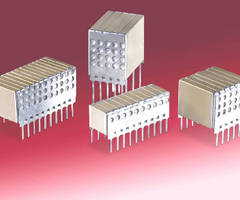
Now available, Holy Stone's compact 'Verti-Zontal' (vertically oriented, horizontally stacked) MLCC capacitors are designed for applications with limited headroom, requiring a high-CV product. This SVZ Series orients individual capacitors vertically, limiting the overall height while the stack itself extends horizontally across the mounting area on the board.

The low ESR design allows for very high CV in the available footprint space. The compact yet high-CV design of these Verti-Zontal stacks is suitable for power applications including input and output filters. Its lead frame construction isolates the MLCC from both thermal and mechanical stresses, which can be problematic with large capacitors.

The Holy Stone design provides outstanding mechanical integrity as the design provides for individual leads to be centred on each cap insert. The low centre of gravity provides superior shock and vibration resistance, so they can be used in harsh environments. The SVZ series is also available using Holy Stone's high-temperature dielectric in temperature ratings up to 200C, in which case it is called the HVZ series.

Geothermal History

n 2010, GTP published a series of four history reports on Geothermal Energy Research and Development in the United States. The reports highlight the history and significant accomplishments of major research programs and projects in geothermal energy exploration, drilling, reservoir engineering and energy conversion in the United States from 1976-2006.
Download A History of Geothermal Energy Research and Development in the United States, 1976-2006:

Technology Validation

GTP works to ensure the viability of applying EGS technology to the production of geothermal energy in the United States. GTP partners with industry in its research and development efforts to verify the application relevance of geothermal technologies and to enhance deployment prospects. This technology validation work is being accomplished through GTP's Field Projects efforts.

Hydrothermal Power Generation

The geothermal power generation industry in the United States is one of the leaders in the world in increasing growth in electric power production from hydrothermal resources. Installed capacity in 2008 is nearly 3,000 megawatts. The industry and technology, however, continues to face challenges in lowering drilling and production costs and in expanding the resources available for production to wider geographic areas. GTP continues to support research and development activities and partnerships to encourage the U.S. geothermal community meet these challenges.

Enhanced Geothermal Systems


Retrofit of a new direct contact condenser at The Geysers
GTP supports R&D activities and partnerships in developing and advancing EGS technologies. EGS are engineered reservoirs created to produce energy from geothermal resources that are otherwise not economical due to lack of water and/or permeability. EGS technology has the potential for accessing the Earth's vast resources of heat located at depth to help meet the energy needs of the United States. DOE estimates that the application of EGS technology is capable of providing at least 100,000 MW of electricity within 50 years.

Photo of a contact condenser


GTP is committed to achieving EGS technology readiness by 2015, and while the R&D effort reflects the long-term goal of cost competitive power production, demonstrating EGS technology applications in the near-term is also important. GTP is facilitating the research and technology developments needed to permit EGS to become a continuous base-load power source in the United States.
To learn more about EGS, watch our EGS animation or read The Basics of Enhanced Geothermal SystemsPDF.

Key R&D Activities

Current work is active in, or planned for the following areas:

Site Selection

Site selection is focused on:
  • Prioritization of sites for future EGS development and estimating the size of the economic EGS resource.
  • Low-risk, economical EGS site selection and characterization capabilities.
  • Drilling, casing, and preparing the wells for simulation and production.

Site Characterization

Identification of preexisting subsurface formation characteristics in order to establish a baseline from which to measure the effectiveness of reservoir creation efforts.

Reservoir Creation

Stimulation of the target formation by fracturing to create the subsurface heat exchanger component of the EGS system.

Reservoir Validation

Improved geophysical methods for downhole detection of fractures and water flow for validation of created EGS reservoirs

Interwell Connectivity

Accurate detection of reservoir characteristics including fluid pathways, dynamics, residence time, etc.

Reservoir Scale Up

Optimization of use of wells and sidetracks. to economically exploit EGS resources

Reservoir Sustainability

Management of EGS reservoirs for maintenance of reservoir lifetime and productivity.

Integrated Systems Research Program Technical Sessions

January 4th and 6th, 2011
AIAA Aerospace Sciences Meeting (ASM)
Orlando, FL

As part of the 49th ASM being held at the Orlando World Center Marriott in Orlando, Florida, the NASA Aeronautics Integrated Systems Research Program (ISRP) will host two technical sessions on January 4th and 6th.

During these sessions, key NASA aeronautics personnel will share their latest plans and research results from ISRP and the Environmentally Responsible Aviation (ERA) Project with fellow technologists, interested experts, and groups from industry, academia, other federal agencies, and the international community.

The technical sessions provide an excellent opportunity to gain insight into the NASA aeronautics mission, as well as program and project details and to exchange viewpoints. Jaiwon Shin, associate administrator of the Aeronautics Research Mission Directorate, will be the introductory speaker.

Session 1: Tuesday, January 4, 2011
8:00 AM-Noon (0800-1200)
Chair: Dr. Edgar G. Waggoner/Co-Chair: Ms. Jean B. Wolfe
Location: Grand Ballroom 8A


Integrated Systems Research Program / Environmentally Responsible Aviation Project Updates
Time Event
8:00 AM (0800) NASA Aeronautics Update
Dr. Jaiwon Shin
8:30 AM (0830) Status Update on NASA's Integrated Systems Research Program
Dr. Edgar G. Waggoner
9:00 AM (0900) Status Update on NASA's Environmentally Responsible Aviation Project
Dr. Fayette Collier
9:30 AM (0930) Assessing Progress Towards Simultaneous Reductions in Noise, Fuel Burn and NOx
Craig Nickol and Larry Leavitt
10:00 AM (1000) X-48B Blended Wing Body Ground to Flight Correlation Update
D. Vicroy and Tim Risch
10:30 AM (1030) Drag Reduction Status and Plans – Laminar Flow and AFC
Anthony Washburn, Ethan Baumann and Albion Bowers
11:00 AM (1100) Airframe Noise Reduction Status and Plans
Mehdi Khorrami
11:30 AM (1130) Status of Advanced Stitched Composite Aircraft Structure
Dawn Jegley and Alex Velicki


Session 2: Thursday, January 6, 2011
2:00 PM-5:30 PM (1400-1730)
Chair: Dr. Fayette Collier/Co-Chair: Ms. Gaudy Bezos-O'Connor
Location: Grand Ballroom 8A


Integrated Systems Research Program / Environmentally Responsible Aviation Project Updates
Time Event
2:00 PM (1400) Status Update on Environmentally Responsible Aviation (ERA) Project
Dr. Fayette Collier
2:30 PM (1430) Fuel Flexible, Low NOx Combustors for Reducing Emissions
Chi-Ming Lee
3:00 PM (1500) Improving Engine Efficiency Through Core Developments
James Heidmann
3:30 PM (1530) The Promise and Challenges of Ultra High Bypass Ratio Engine Integration
Chris Hughes and Steve Smith
4:00 PM (1600) Re-establishing Open Rotor as an Option for Significant Fuel Burn Improvements
Dale Vanzante
4:30 PM (1630) Status of Hybrid Wing Body Community Noise Assessments
Russell Thomas
5:00 PM (1700) Advanced Vehicle Concepts for Simultaneous Reductions in Noise, Fuel Burn, and NOx
Mark Mangelsdorf and Gaudy Bezos-O'Connor

Building Materials & Construction

New Insulation for Retrofitting Existing Buildings
Student: Ellann Cohen
Buildings consume too much energy. For example, nearly 14% of all the energy used in the United States goes towards just the heating and cooling of buildings. Many governments, organizations, and companies are setting very ambitious goals to reduce their energy use over the next few years. Because the time periods for these goals are much less than the average lifetime of a building, existing buildings will need to be retrofitted.
There are two different types of retrofitting: shallow and deep. Shallow retrofits involve the quickest and least expensive improvements often including reducing infiltration around windows, under doors, etc and blowing more insulation into the attic. Deep retrofits are those that involve costly renovation and typically include adding insulation to the walls and replacing windows. A new, easily installable, inexpensive, and thin insulation would move insulating the walls from the deep retrofit category to the shallow retrofit category and thus would revolutionize the process of retrofitting homes to make them more energy efficient.
For my thesis, I am working on the development of a new, easily installable, inexpensive and thin insulation. The basic design idea for this new insulation is to have a silica aerogel (the lowest thermal conductivity material known today) based insulation that will have superior insulative properties as compared to conventional insulations. It will also be thin enough that it can be installed on the inside walls of buildings while still adding substantial R-value.
Composite Materials for Building Envelopes
Principal investigators: Leon Glicksman, Leonard Morse-Fortier, Lorna Gibson, John S. Crowley
Sponsors: Alcan International Ltd., Dow Chemical USA, GAF Corp., Hoechst-Celanese, Macmillan Bloedel Ltd., Miles Chemical Corp., USG Corp., Certaineed Corp., GE Plastics and Weyerhauser Co.
Traditionally the envelopes of houses are site-assembled from basic components with separate materials serving as the structural members, the weather shield, and the thermal insulation. In this recently completed project composite materials were developed that combined these separate functions. In addition, a construction system well suited to automated fabrication and simple field assembly is being developed. A proof-of-concept roof system, the first product of this research, is based on innovative design and analysis strategies and is compatible with conventional systems while minimizing house-specific design. The roof components include thin-ribbed stress-skin panels, a multi-function ridgebeam and a spline-connection scheme.
Advanced Thermal Insulations
Principal investigator: Leon Glicksman
Sponsor: U.S. Department of Energy
New buildings and renovated existing buildings, as well as appliances, can be made more energy efficient by the use of insulations which are more compact for the same level of performance. Recently completed research on closed-cell foam insulation improved its insulating performance and at the same time allowed it to be manufactured with elements which are not hazardous to the environment (in particular which do not deplete the ozone layer). Advanced insulation, which includes a composite of foam and vacuum technology, was also developed.
Thermal Insulation for Developing Countries
Principal investigators: Leon Glicksman and Les Norford
Sponsors: ICI Polyurethanes, American Society of Heating, Refrigerating and Air-Conditioning Engineers
In a number of resource-poor developing countries, buildings are constructed of masonry material without thermal insulation. In winter, these buildings are uncomfortably cold or even uninhabitable. MIT is developing a low- cost thermal insulation for such countries. The feedstock for the prototype insulation is straw, a by-product of wheat threshing. The investigations have focused on straw density, the type and amount of binder needed to make straw panels, thermal and structural tests, and means of attaching the panels to stone walls and applying a surface finish. MIT students have made on-site surveys and prototype tests in Pakistan.
Identification and Promotion of Locally Sustainable Building Construction Methods for Latter-stage Slum Improvement
Principal investigator: John E. Fernandez
Sponsor: 3M Innovation Award
Slum-improvement strategies are a result of conclusions drawn from the most successful projects that have addressed city-center squatter communities. While the factors that need to preside in successfully addressing the needs of the residents of these settlements are complex and necessarily mutable depending on location and overall purpose of the project, it has been recognized by a wide range of organizations that the upgrading, as opposed to physical removal, of slums is a better long-term solution. The creation of mechanisms, financial, political and institutional, that provide a well-conceived ‘package’ of service infrastructure and the establishment of land tenure are the most important first steps in alleviating the health risks and economic hardships that the residents endure. Later, the sustainability of these improvements should lead to an increased desire to upgrade the physical quality of the dwelling units themselves. This project proposes the identification of locally sustainable methods of construction for dwelling upgrade as a strategy for catalyzing the development of viable income producing activities within and adjacent to the confines of the slum itself. This promotion is in the service of establishing a sustainable process of continual slum-improvement after the work of this project has been completed. The identification of construction methods and the consideration of innovative materials and assembly systems will contribute to a realistic proposal for a set of building components to be used in the upgrade of dwelling units. The location of the project is to be determined.
Center for Sustainable Materials and Building Envelopes
Principal investigator: John E. Fernandez
Sponsor: Department of Energy
The study of sustainable materials necessarily involves an extremely large set of scientific and economic criteria to reasonably establish a productive comparative analysis. While a number of systems have been proposed and developed, none has secured a clearly predominant position over all others. Therefore, it is necessary to glean from a great number of sources the necessary information and rating criteria to offer a current and productive assessment of the state of rating materials for their sustainable value. This proposal offers to study the available literature and tools for determining the sustainability of construction materials for the purpose of:

  1. establishing the state of the art of ratings systems and their attendant criteria,
  2. identifying the most recent and important innovations in sustainable material technologies, and identifying key areas for further research.
Three-dimensional Fiber Textile Composites for Use in Construction
Principal investigator: John E. Fernandez
Three dimensional fiber composites have resulted from a search for viable alternatives to 2D composite laminates. As a result of increasing concern regarding the difficulty with which 2D composites have been able to address delamination from impact, in-plane shear stresses and transfer of axial and bending stresses between adjacent composite elements, 3D fiber textile composites (FTCs) have recently received greater attention. For many reasons, the industrial application of 3D FTCs has lagged far behind the use of 2D composites in high-performance industries such as aerospace and large-scale marine structures. However, several isolated yet noteworthy applications have been implemented in less demanding performance scenarios for civil and architectural structures. The lower level of performance requirements makes the use of 3D FTCs a possible way in which to lighten and strengthen typical structural and non-structural components used in civil and architectural structures. In addition it is possible that 3D FTCs may provide a versatile medium for the inclusion of specialized fibers for a variety of enhanced properties. One particularly interesting possibility arises from the inclusion of “smart” or “responsive” fibers within the architecture of the 3D FTC.
Natural Fiber Reinforcement of Large-Scale Composite Polymer Panels
Principal investigator: John E. Fernandez
Recently, natural fibers (NF) have been investigated as filler materials capable of serving as localized tensile reinforcement and volume fillers within several types of polymer matrices. A number of natural fibers have been under continued investigation for use in natural fiber reinforced polymer composites (NFRC); including wood fiber, jute, sisal, kenaf, flax, wheat straw and bamboo. These fibers have been coupled in a matrix primarily composed of two commodity plastic matrix materials: polyethylene (PE) and polysytyrene (PS). While specific mechanical properties of natural fibers vary according to the particular fiber, the overall performance of natural fibers lies within a relatively tight range as a result of similar molecular composition. An increasing amount of interest has developed over the past few years for NFRCs because of their ease of production, subsequent increase in productivity, cost reduction, lower density and weight and use of renewable resources. The automobile industry has begun to apply NFRCs in a variety of exterior and interior panel applications. The significant weight savings and the ease and low cost of the raw constituent materials have made NFRCs an attractive alternative material to glass and carbon fiber reinforced polymer composites. However, further research needs to address significant material and production obstacles before commercially available NFRCs are widely used in architectural and civil works.
Fiber Reinforcement of a Composite Exterior Wall Panel for the Purpose of Resisting High-velocity Impact Events
Principal investigator: John E. Fernandez
The introduction of fiber reinforcing into the exterior finish component of an exterior wall assembly may aid in preventing catastrophic failure of the integrity of the wall during events in which high-velocity impact is likely. The most important events to address are those conditions caused by naturally occurring high winds and blast events. During these events, it has been observed that a wide range of objects become lethal projectiles that pose significant hazards to both personal injury and property damage. While layered polymer composites have demonstrated an increasing level of resistance to projectile impact, significant difficulties remain that require further research. In particular, delamination from low and high velocity impact has been a major problem that threatens the structural integrity of the panel. The use of composites for exterior sheathing is a growing area for research and architectural and civil applications in the US, and especially in Europe and Japan. For the advancement of the use of large-scale composite panels for exterior sheathing, further research regarding resistance to impact should be undertaken.
Self-healing Smart Fiber Inclusion into an Air/vapor Barrier Textile Substrate Material
Principal investigator: John E. Fernandez
Self healing fibers have received a significant level of interest primarily with applications for inclusion in reinforced concrete as a crack management strategy. These “smart fibers” have been added as discrete elements within the concrete matrix. The self-healing fibers are primarily fluid-filled hollow capillaries that contain a bonding agent that, when released, slow or prevent the spread of a crack through the concrete matrix. Self-healing fibers have also been proposed as a strategy for addressing debonding events between the concrete matrix and reinforcing bars. Another application is proposed for this type of smart fiber. The management of the transfer of heat through an exterior wall is an important aspect of the thermal performance of that envelope; one that is substantially compromised by air infiltration and exfiltration. Standard building practice, especially in residential construction, usually requires that a membrane be applied to the building volume to reduce the movement of air between the interior and exterior. Any discontinuities in this membrane may allow for the passage of air to and from the exterior. Self-healing fibers, as an inclusion within the weave of an air/vapor barrier textile, will be studied as a strategy for passively sealing the miscellaneous discontinuities that arise during the application and lifetime of the membrane.
Incorporation of a Smart Fiber Network within a 3D Fiber Textile Composite Near-net Preform Structural Member for Remote Structural Monitoring
Principal investigator: John E. Fernandez
3D fiber textile composites are a type of fiber architecture that allows for the inclusion of a variety of fiber types within a three-dimensional near-net preform network. The inclusion of monitoring “smart fibers” within the architecture of the woven material allows for the through-member permeation of a fibrous sensor material. Typical fiber materials used for stress and strain monitoring are optical glass fibers linked to a central processor. In this way it is possible to gather important information regarding the health of a structure during construction and during its lifetime from a remote location. The study proposes to evaluate fibers for inclusion within a 3D FTC structural member as well as propose various sensor network architectures most productive for the applications listed. The materials chosen need to conform to the stresses inherent in the pultrusion and weaving processes during the production of the standardized structural forms.

Followers